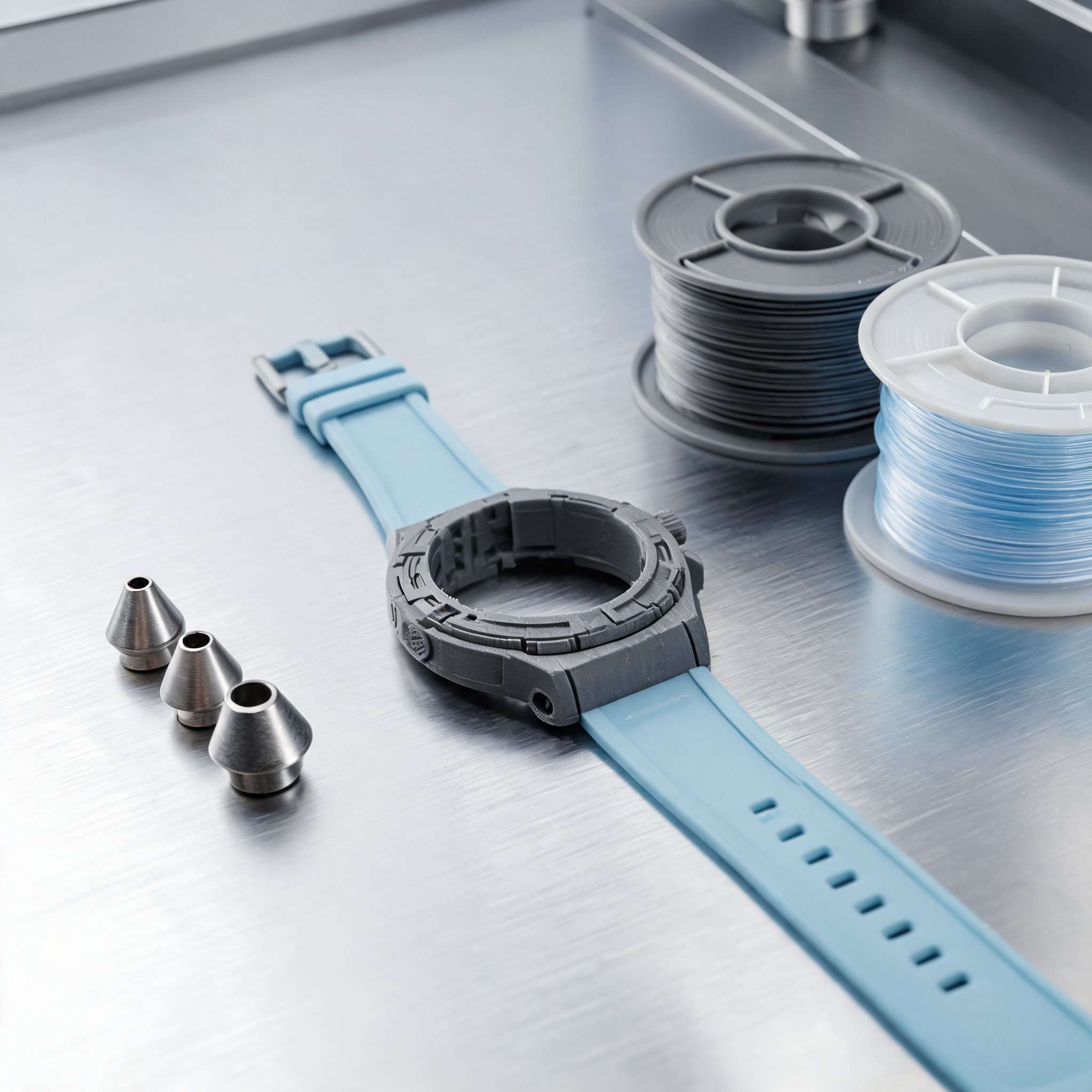
Bambu is gradually revealing features of its upcoming H3C 3D printer, and the latest teaser focuses on multi-nozzle and multi-filament compatibility. After earlier promoting multi-color output, the company has now shown a multi-component watch print that combines different nozzle diameters and filament types in one job.
According to the teaser, the rigid case uses a 0.4 mm nozzle with 1.75 mm filament, the fine details use a 0.2 mm nozzle with 1.75 mm filament, and the soft strap uses a 0.4 mm nozzle with 2.85 mm filament. The strap material is indicated as possibly TPU. The image therefore points to two developments: Bambu appears to be adding 2.85 mm filament compatibility for soft, rubbery materials, and it is suggesting that 0.2 mm and 0.4 mm nozzles can be used within the same print.
That second point addresses a long-standing request from users of Bambu's H2D and H2C printers, and possibly the more recent X2D. The report notes that Bambu has not allowed users to mix 0.4 mm and 0.2 mm nozzles in one print job; only a single nozzle can be selected. The new teaser implies that multiple nozzle and filament sizes can be combined, likely in a multi-object print. Existing dual-nozzle machines, however, still face software limitations that prevent this.
The teaser leaves open whether mixed nozzle sizes will come to all compatible Bambu printers or only to the upcoming flagship H3C and P3C models. The P3C has not been formally announced, while the H3C has. Bambu has also released a teaser video showing watch components printed in place as a single part with multiple nozzle and filament sizes, reinforcing the direction of the feature without confirming the full rollout.