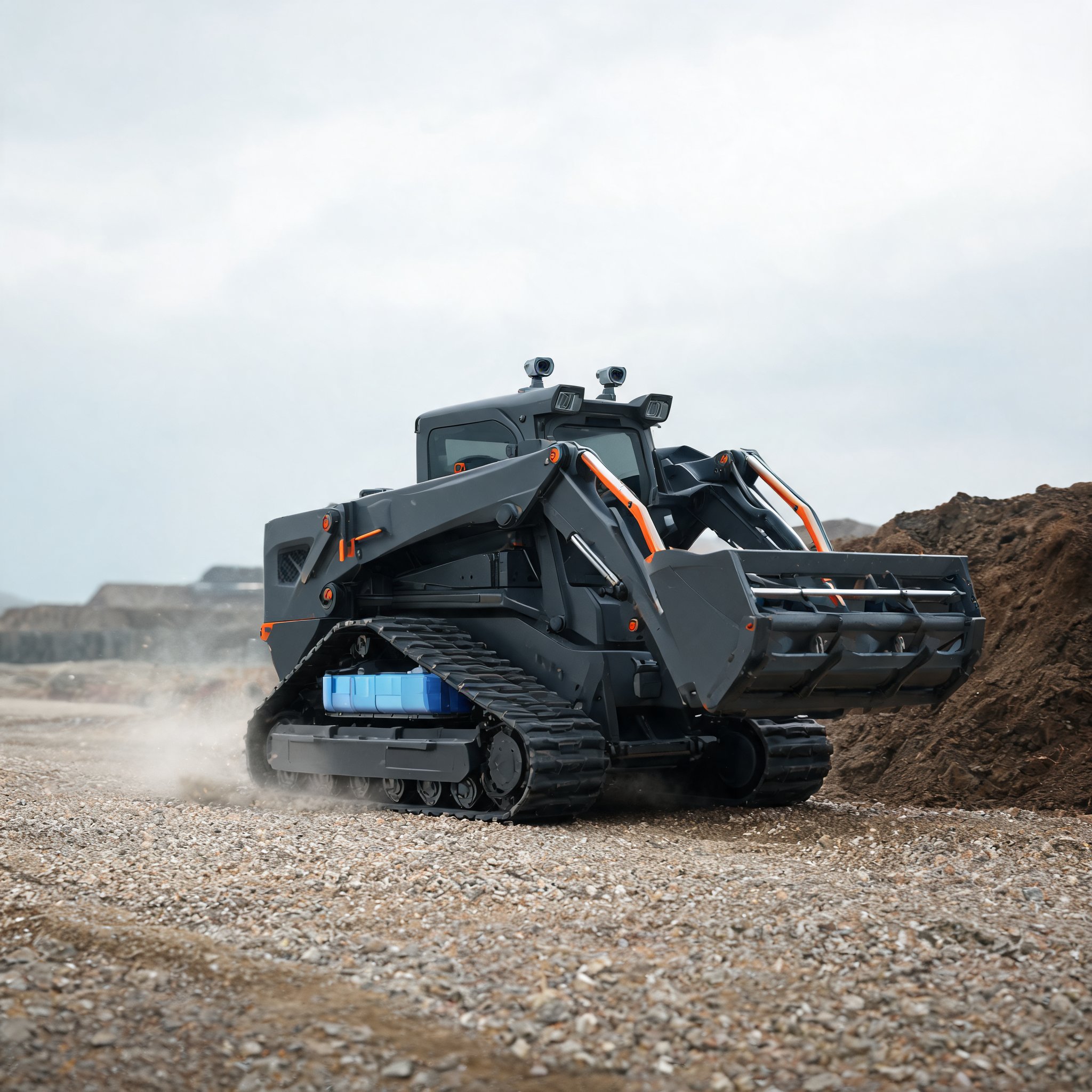
Bobcat Company has received its second Red Dot Award: Design Concept for the RogueX3, a fully electric, autonomous and modular concept loader. The award follows the 2024 recognition of the RogueX2 and extends the RogueX concept platform’s work in the design competition. Bobcat says the recognition highlights its continued exploration of adaptable machine architectures intended to address workforce challenges, sustainability goals and increasingly connected jobsites.
Jim Breuer, Bobcat’s director of global product identity, said the award reflects the company’s commitment to exploring future equipment through the RogueX platform. He said the RogueX3 shows how industrial design and engineering can combine to give form to autonomy, electrification and modular architecture, helping customers envision the future potential of equipment.
Simplified tilt system
Central to the RogueX3 design is a patent-pending, rear-mounted linear actuator tilt system. The configuration replaces traditional front hydraulic cylinders and reduces the number of mechanical components by more than 50 percent compared with a typical compact loader, according to Bobcat. By reducing hydraulic complexity, the design explores ways future compact equipment could be easier to maintain, more energy-efficient and better suited to increasingly automated jobsites.
Integrated electric architecture
The concept also incorporates a chassis-integrated battery and an electric drivetrain for zero-emission operation. Integrating the battery into the chassis lowers the machine’s centre of gravity and creates a more streamlined, efficient architecture, Bobcat says. The platform supports tracked or wheeled mobility, cabbed or cabless operation, multiple lift-arm geometries and configurable power systems, allowing one platform to adapt to different terrains, industries and future jobsite needs.
Autonomy and remote control
RogueX3 uses technology capable of real-time kinematic positioning, GPS navigation, sensors and cameras to support autonomous functionality. It can also be operated through Bobcat MaxControl, a remote operation system designed to control equipment from outside the cab using an iPhone or another device running the iOS operating system. Future technology work involving AI-enabled lighting systems is intended to explore how equipment could communicate machine activity, such as status and intent, to people on the jobsite.
Research platform, not a product
Developed through collaboration among Bobcat’s Global Design Studio, Global Innovation and engineering teams, the RogueX3 serves as a research platform for testing technologies and design approaches that could shape future generations of Bobcat equipment. It was introduced at CES 2026 and remains in the research and development stage; it is not commercially available.
Joel Honeyman, Bobcat’s vice president of global innovation, product insights and dealer enablement, said customer needs are evolving as jobsites become more connected, and equipment must become more adaptable. He said the RogueX3 explores how a single modular platform could respond to different jobs, terrains and power systems, resulting in a simpler, more efficient architecture built around changing construction crew needs.