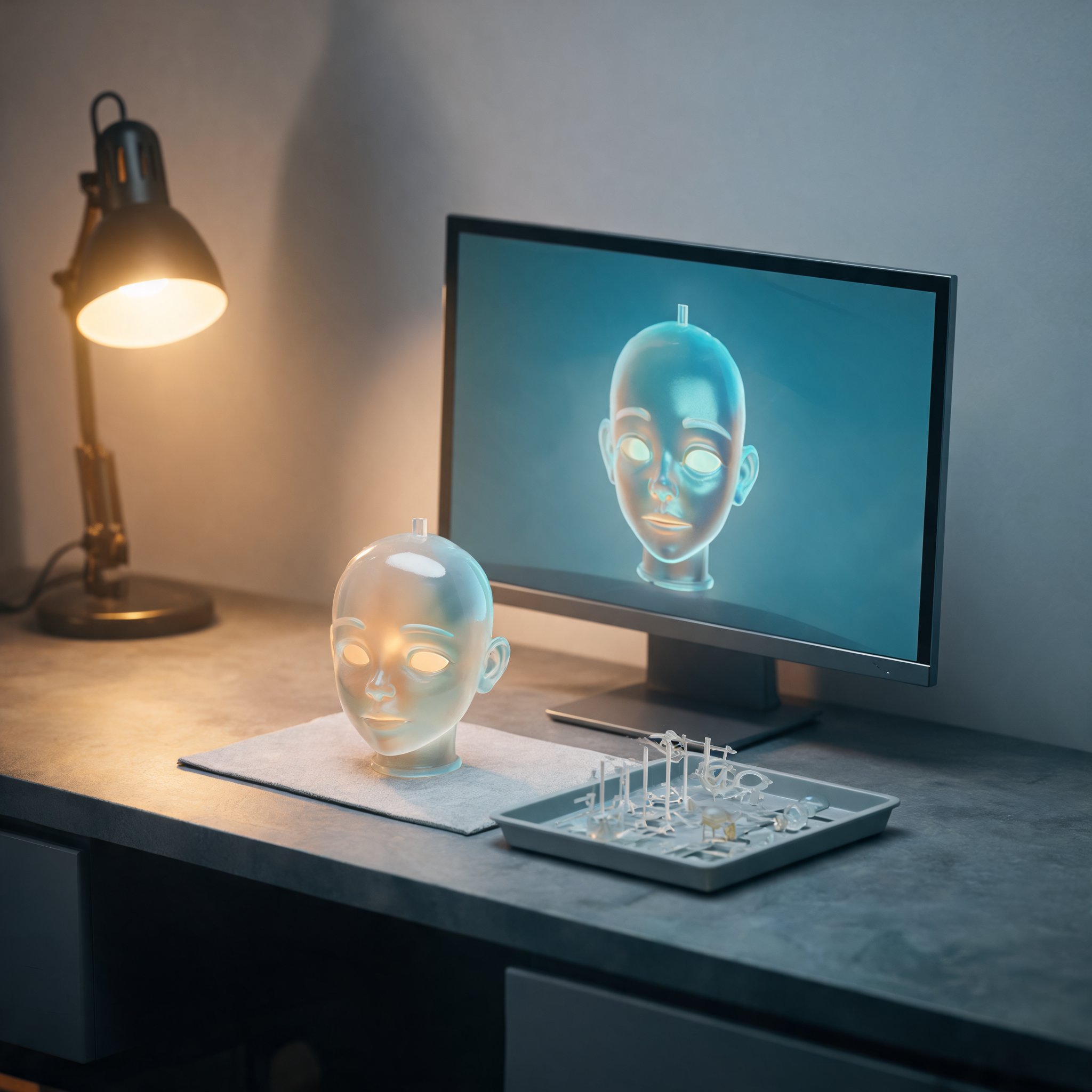
Additive Appearance, a Prague-based software developer, has signed an agreement with stop-motion studio LAIKA to add its PrismSlicer renderer to the 3D printing tools available to the studio's artists. The software estimates how color and translucency will appear in a PolyJet print before the part is produced, with the goal of a predictable match between the digital design and the physical object.
The agreement addresses a recurring problem in full-color 3D printing: what appears on screen does not always carry over to the printed part, and each mismatch can mean another print. LAIKA produces hundreds of thousands of detailed faces for every film, so reducing those extra rounds affects both production time and quality assurance.
Previewing appearance before printing
PrismSlicer generates an initial preview of a model's color, translucency and surface appearance before printing, including under LAIKA's custom studio lighting environments. The stated aim is fewer print iterations.
Robert Ducey, Technical Supervisor at LAIKA, said the software has the potential to give the studio's artists predictive previews of their digital designs in those custom lighting setups, describing it as a crucial advance that allows faster iterations when developing assets for full-color 3D printing. Reliable, fast renders, he added, have the potential to reduce development time significantly.
Initial projections from the two organizations indicate the visualizations could lower the number of print iterations and raise artist satisfaction through quicker feedback.
A seven-month trial against production criteria
The agreement targets a predictable match between on-screen designs and printed parts. Across a seven-month evaluation period, PrismSlicer gained a command-line interface to support automation, and its simulation backend received new features intended to make the renders more realistic.
Research roots at Charles University
Additive Appearance is a spin-off of Charles University in Prague, and its team is made up of engineers and researchers. The partnership with LAIKA builds on years of joint development and material research carried out with the university's Computer Graphics Group, work that addresses two problems: optically measuring the materials used in PolyJet 3D printing, and precisely matching photographs to renderings. The company says it designs its tools to work with a wide range of hardware platforms and for users across different industries.
Tobias Rittig, CTO at Additive Appearance, said the studio's trust validates the company's mission to make full-color 3D printing as predictable and expressive as 2D imaging. Both teams expect the collaboration to lead to further work in full-color 3D printing, including new ways to combine digital and physical workflows in creative production.
LAIKA was founded in 2005 outside Portland, Oregon, and received a Scientific and Technology Oscar in 2016 for its work in 3D printing. Its newest feature, Wildwood, opens on October 23, and the studio said it selected PrismSlicer with future productions in mind.
Earlier efforts to close the color gap
- For Missing Link, LAIKA combined Stratasys J750 printers with the Cuttlefish 3D printer driver from Fraunhofer IGD to print more than 106,000 facial expressions. Brian McLean, then the studio's Director of Rapid Prototype, credited the software's color consistency and geometric accuracy. Cuttlefish is a voxel-based driver that works with multiple printing materials at once and accounts for light dispersion, hue and surface texture to reproduce a model's appearance in the printed part.
- Stratasys approached color mismatch from another direction when its J735 and J750 PolyJet printers received Pantone validation in 2019, integrating the Pantone Matching System into the workflow so designers could select colors from a shared reference palette and avoid misinterpretation.
The methods differ: Pantone standardizes color selection against a reference, whereas PrismSlicer renders how a specific model will look once printed. With PrismSlicer, LAIKA adds a simulation step before printing to a face production process that has previously drawn on specialized appearance software.