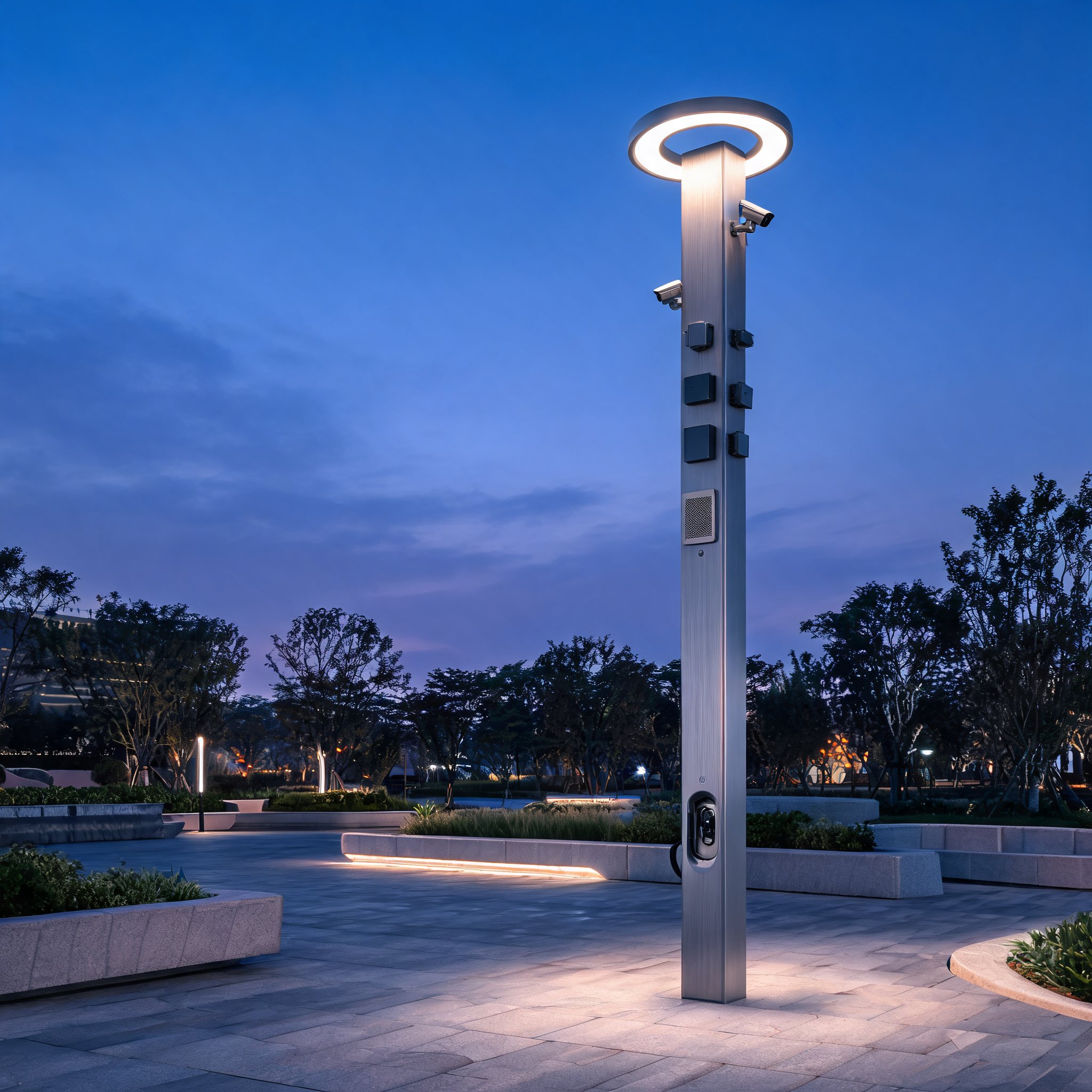
Landscape Forms has relaunched SHUFFLE, a modular smart-pole system designed to bring Wi-Fi, cameras, sensors, two-way communications and electric-vehicle charging into a single vertical structure for public spaces. The company says the system responds to demand from municipalities, campuses and commercial developers for more site functions without adding separate single-purpose fixtures or visual clutter.
SHUFFLE is built around stackable modules that can be configured for different sites and updated as needs change. Landscape Forms describes installation and activation as straightforward, and the integrated design as bringing a modern appearance to busy, multi-use environments. The system is intended for locations where space is limited but connectivity, safety and power needs are growing.
Configuration and new modules
Landscape Forms has added a build feature to its website that lets clients specify preferred camera and technology brands and select from available options within each category. The company says this simplifies specification while preserving flexibility.
New feature updates include plug-and-play options for a 360-degree area light, a decorative light ring, a 180-degree area light, quad-view and 180-degree cameras, motion sensors, and loudspeaker and intercom modules. These additions broaden the ways the pole can be equipped for lighting, surveillance, sensing and two-way communication.
Applications and design intent
According to Landscape Forms, the modular design can be adapted for specialized environments as well as general public spaces. Potential settings cited by the company include university and business campuses, airports and commuting hubs, shopping malls and tourist areas, concert halls, city parks, sports venues and hospitals. In those locations, the system is positioned as a way for site managers to address multiple requirements through one product family.
Shannon Lee, business development manager for smart poles at Schréder, said in a statement that SHUFFLE was designed for busy public spaces and can be updated as a site’s needs evolve. She said safety and connectivity can be integrated into outdoor spaces without the technology dominating them, making the system easier to access and use.
Jordan Agustin, president of lighting at Landscape Forms, said the relaunch reflects the idea that technology and design should work together to make outdoor spaces safer and smarter without compromising aesthetics. He said the new features are integrated into a streamlined design and support the company’s broader mission of connecting people to the outdoors and to each other.
What the relaunch changes
The relaunch does not introduce a new standalone device category; rather, it expands a configurable platform that combines functions usually installed as separate fixtures. For specifiers, the main change is the ability to choose camera and technology brands through a simplified online configuration process and to add lighting, camera, sensor and communications modules within the platform.
Landscape Forms is presenting SHUFFLE as a response to the practical constraints of public-space design: limited room for new infrastructure, rising expectations for connectivity and safety, and pressure to avoid visual and cost burdens. The company’s claims about ease of installation, adaptability and aesthetic integration are product-positioning statements; the announcement did not include independent performance data or installed-project results.