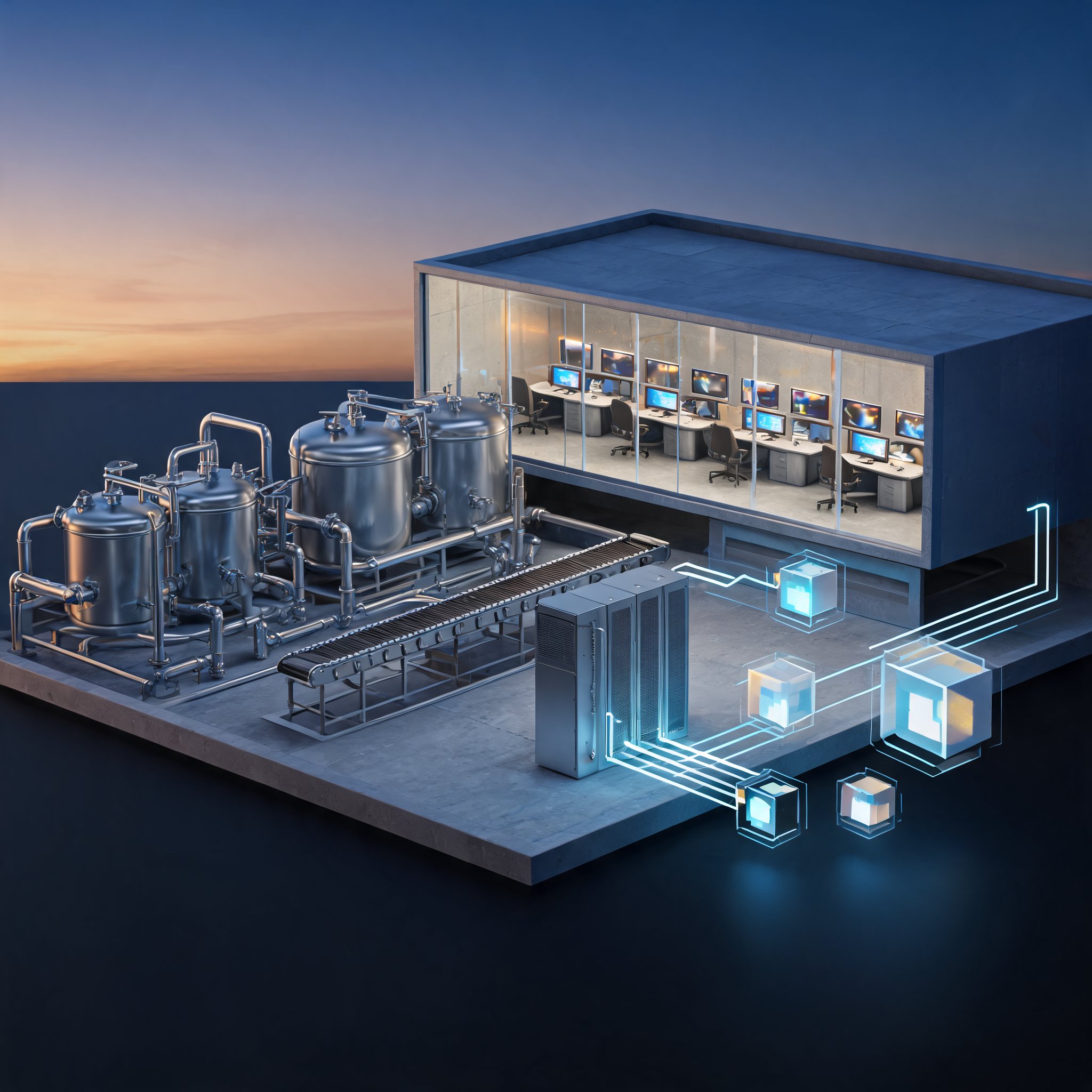
Schneider Electric has announced a strategic collaboration with NVIDIA and HPE aimed at accelerating Physical AI adoption in process and heavy industries. Rather than focusing only on robots, humanoids and autonomous machines, the companies are targeting continuous industrial operations where reliability, safety, cybersecurity and energy efficiency are central to performance.
The initial demonstration is Industrial AI Agents at the Edge. It combines HPE Private Cloud AI, co-engineered with NVIDIA as part of the HPE AI Factory with NVIDIA portfolio, with Schneider Electric's operational technology expertise. The goal is to let organizations deploy and scale AI applications at the industrial edge, keeping real-time intelligence near critical operations while retaining control over sensitive data, security and costs.
Why edge deployment matters
Schneider Electric says industrial customers face barriers when scaling AI across operational environments, including data governance, cybersecurity, operational performance and deployment requirements. The edge approach is intended to address three constraints. First, critical operational data may be too valuable, sensitive or regulated to move outside operational boundaries. Second, greater connectivity can widen the attack surface across industrial and critical infrastructure environments. Third, cloud-based inference, data transfer and token-related costs can rise as AI use expands.
HPE Private Cloud AI is positioned as the secure foundation for the agents. By keeping and processing data close to its source, the companies say the solution can reduce exposure and help organizations maintain control, security and compliance. They also say edge deployment can reduce some AI consumption costs and give customers more control over where and how workloads run.
Three initial agents
Customers can deploy, manage and govern multiple Industrial AI Agents through Schneider Electric's EcoStruxure Industrial Insights applications. The first three agents focus on operational technology monitoring, cybersecurity and energy optimization:
- OT Monitoring Agents combine real-time operational data, equipment configurations, process topology, alarms, maintenance history and engineering context to understand the physical state of operations. They identify emerging issues, assess likely operational impact, recommend or initiate corrective actions and verify whether an intervention produced the expected physical outcome.
- Cybersecurity Agents correlate network activity, control system behavior, asset configurations, operational events and process context to detect abnormal conditions. They assess potential operational impact, recommend or execute response measures and validate that systems return to a secure and stable state.
- Energy Optimization Agents integrate process data, energy consumption patterns, equipment performance, operating conditions and production requirements. They identify optimization opportunities, recommend or implement adjustments and verify the resulting effect on energy efficiency, operational performance and sustainability outcomes.
Initial operational foundation
The companies point to CMPC Chile, part of Empresas CMPC S.A., and its OTMS deployment as an operational foundation. For three years, the pulp, paper and packaging producer has used Schneider Electric's OTMS in production to monitor the health and availability of control systems across continuous operations. OTMS gives teams a unified view of control systems, servers, workstations and switches, helping specialists find emerging issues earlier, diagnose problems faster and set clearer maintenance priorities.
That deployment is presented as a foundation for future Industrial AI Agents, with the potential to speed investigation and decision-making while keeping people in control of critical actions. It does not by itself demonstrate the performance of the new agents.
Gwenaelle Huet, Schneider Electric's executive vice president for industrial automation, said the next generation of industrial innovation will be driven by intelligence embedded directly in operations. She said the collaboration brings together automation, AI and edge computing expertise to help customers turn operational data into action and lay a foundation for more autonomous operations. NVIDIA's Sri Kodali said combining NVIDIA Nemotron open AI models and HPE Private Cloud AI with Schneider Electric's industrial expertise and OTMS can help agents monitor, reason and optimize operations in real time. HPE's Alexia Clements said the approach helps customers bring AI closer to where data is generated and decisions are made while maintaining security, privacy and control.
CMPC Chile's Matías Jory said OTMS has improved visibility into control system health and availability over the past three years, and that early issue identification is critical in continuous operations. He sees potential for AI agents to build on that foundation and help specialists investigate faster while people retain control of critical decisions.
The companies describe the work as a foundation for increasingly autonomous industrial operations. Wider adoption will depend on how customers deploy the agents, govern operational data and validate results in their own environments.