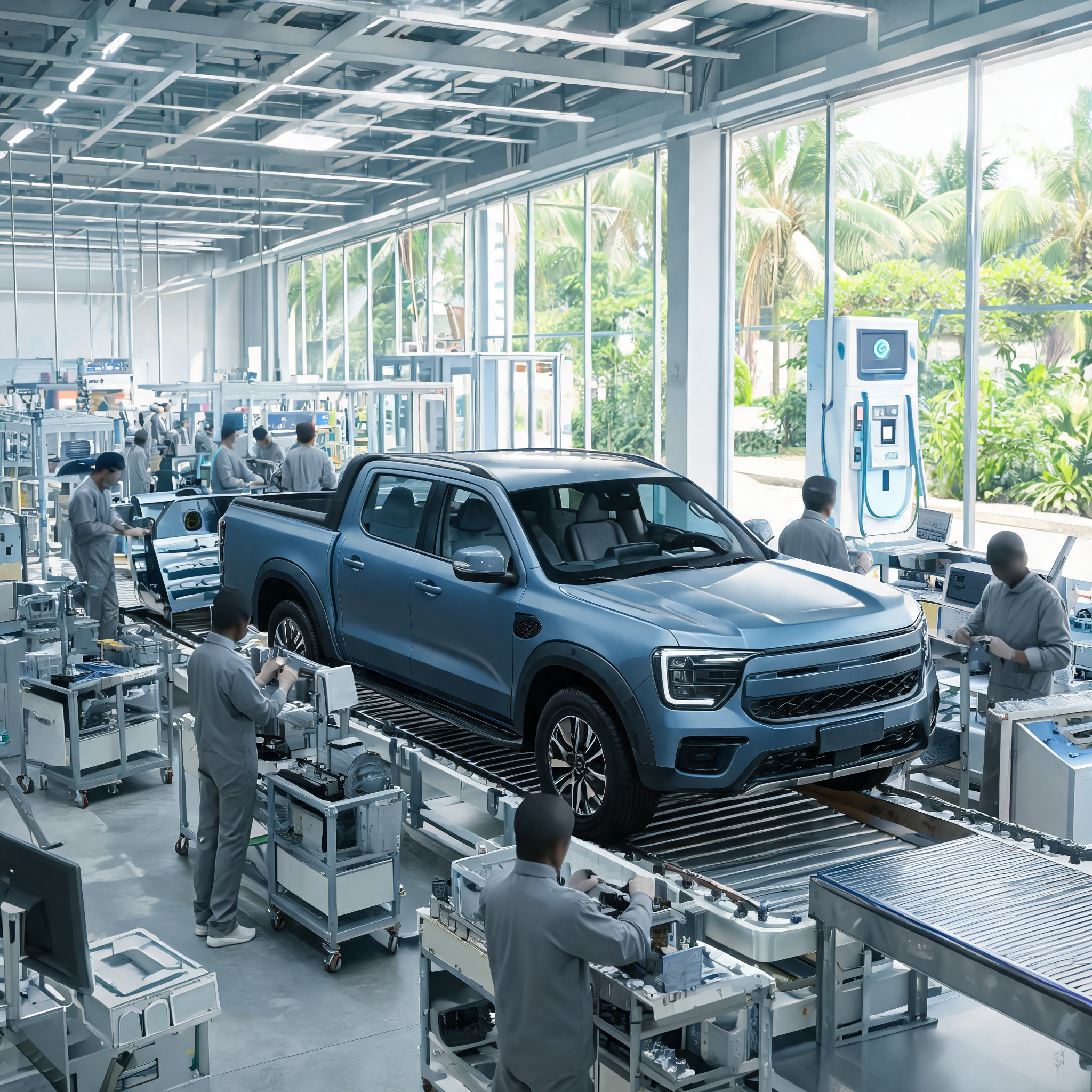
Thailand's Board of Investment (BoI) has approved a 1.49 billion baht (around €39 million) investment by Toyota in its Ban Pho plant in Chachoengsao Province, where the company intends to build the Hilux fuel-cell electric vehicle. According to the BoI, the model would be the first hydrogen fuel-cell electric vehicle manufactured in Thailand.
The approval covers a new production line dedicated to the FCEV derivative. The Ban Pho site already assembles the ninth-generation Hilux with combustion engines, as a mild hybrid and as a battery-electric vehicle, so the hydrogen version joins an existing multi-powertrain line-up rather than a standalone facility. Toyota expects production of the Hilux FCEV to begin in December 2027. The company also plans to install a hydrogen refuelling station on site to support both manufacturing and testing of the vehicles.
Export-first, low-volume programme
Output is planned at roughly 3,000 units a year, which Toyota treats as a niche offering rather than a volume replacement for diesel or battery-electric versions. Initial production is intended for export only. According to the BoI announcement, European countries, Australia and New Zealand will be the priority destinations.
The arrangement contrasts with Toyota's battery-electric Hilux, which the company launched in Thailand before any other market worldwide. Hydrogen therefore starts as an outward-facing technology for the Thai plant, while the domestic market receives the BEV first.
What the teasers show
Toyota presented the first teaser images of the Hilux FCEV at IAA Transportation 2026 last month. The pictures indicate only minor styling differences from other ninth-generation variants: a daytime running light signature split into three separate segments along the upper edge of each headlamp, and what appears to be a closed upper grille area of the kind used on the Hilux BEV. The vehicle in the teasers carried a paint finish similar to the Force Blue colour Toyota offers on the Mirai.
Toyota is targeting a towing capacity of up to 2.5 tonnes and a driving range of more than 400 kilometres for the production model. The market launch is planned for 2028, after manufacturing starts in Thailand.
Dakar as a test bed
Before the showroom launch, Toyota's motorsport division Gazoo Racing is expected to test the underlying fuel-cell technology in its DKR GR FC Hilux at the Dakar Rally's Future Mission 1000 category in 2027. The rally build uses two fuel-cell stacks with a combined output of 400 kW and four high-pressure hydrogen tanks with a total storage capacity of 8.4 kg. Data collected during the event could help Toyota refine its fuel-cell technology for the road-going Hilux FCEV.