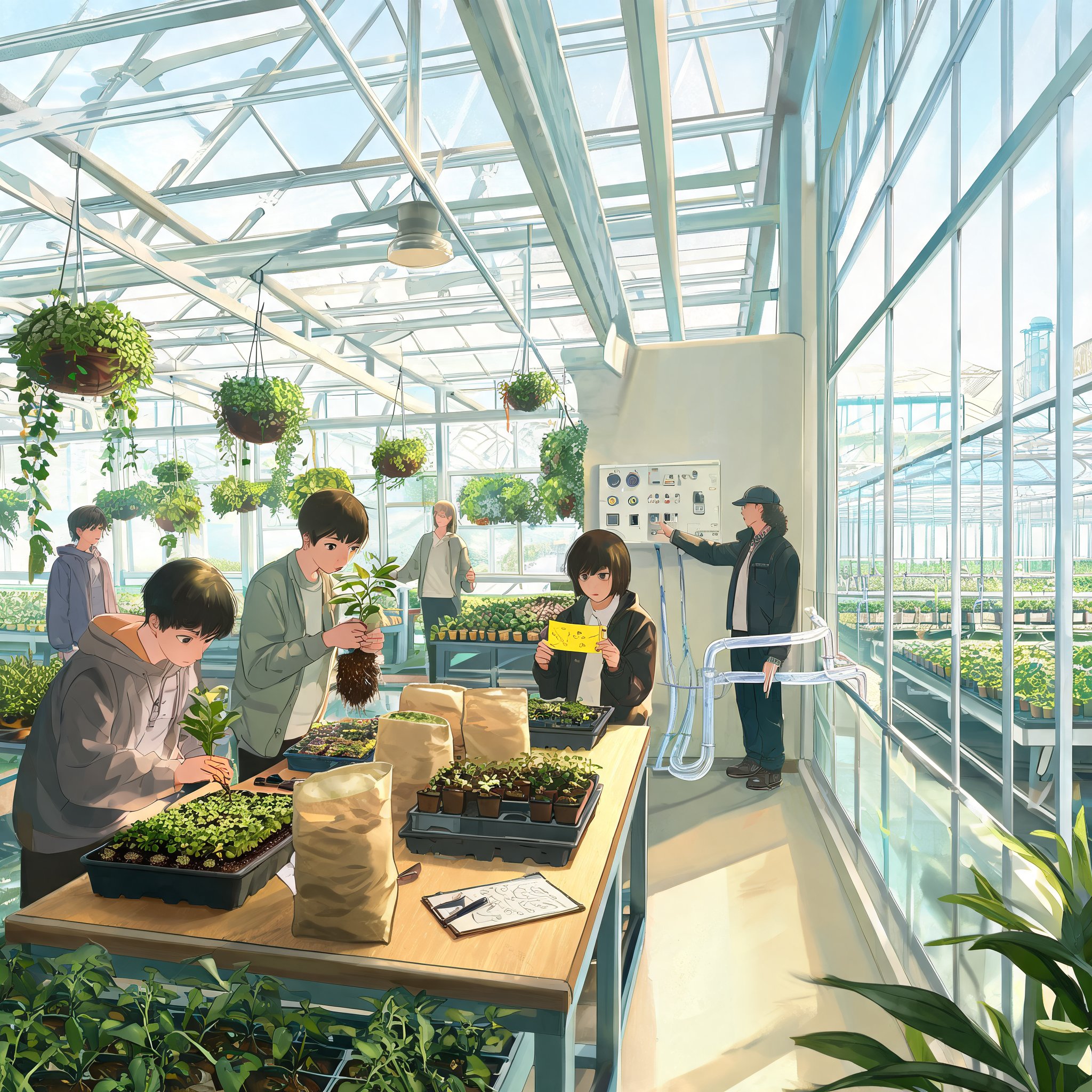
Jeff Neese begins with a familiar industry complaint: growers are hard to find, especially those with practical production experience. But he argues that the search for assistant growers, college graduates and succession candidates begins too late. Before asking where the next generation will come from, the industry should ask where young people are supposed to discover horticulture. A 15- or 16-year-old is unlikely to wake up one morning and decide greenhouse production sounds like a fascinating career. Someone has to show them.
For Neese, that someone was a pair of teachers at Warren Central High School in Indianapolis. He remembers walking into the school greenhouse during an Indiana winter: cold and gray outside; warm, humid, green and alive inside. He did not realize it then, but the doorway would shape his life. Vocational horticulture gave him Phil Pitts and Pam Greene. Pitts brought real-world experience as a grower and landscape designer and set high expectations. Greene taught floriculture. Together, they let him experience horticulture before he had to decide what to do with his life.
The program was not a light introduction. Students were not there merely to memorize plant names, fill out worksheets or grow a few plants for a spring fundraiser. They were expected to understand plants and learn how to grow them well. Pitts understood that horticulture does not follow a school schedule: plants need water on weekends, pests and diseases do not wait until Monday, and crops respond to light, temperature, water and nutrition whether school is in session or not. Neese says he was not simply learning about horticulture; he was beginning to see himself in it. After high school, he went directly into the industry. He does not diminish higher education—the industry needs university-trained horticulturists, researchers and growers—but he argues that college should not be the first place a young person discovers horticulture, nor the only respected route.
The essay’s practical proposal begins with a limit. A greenhouse behind a school is not enough. It is a living laboratory, and operating one requires knowledge, commitment and time. Agriculture teachers may cover broad subjects; expecting each to also be an accomplished greenhouse grower, crop scheduler, irrigation specialist, diagnostician, IPM practitioner and environmental-control expert is unrealistic. Nor should teachers have to develop those skills alone. Neese believes commercial growers should step in—not wait for schools to produce qualified employees, but become partners in helping schools develop them.
He sketches a division of labor. A commercial operation could essentially adopt its local school greenhouse—not to take it from the teacher or dictate curriculum, but to serve as a technical resource. Growers could help develop an achievable crop plan and realistic standards for irrigation, fertility, pH, EC, temperature and crop timing. They could walk the greenhouse with students and teach them how to scout rather than simply saying what is wrong with a plant. They could show how sticky cards work, how roots are examined and how nutritional problems are diagnosed. Most important, they could show how growers think through problems and make decisions, help teachers use existing equipment and give them someone knowledgeable to call when something goes wrong.
That transfer matters because the industry holds practical growing knowledge, yet most of it stays inside commercial greenhouse walls. If the industry is serious about its future workforce, some of it needs to reach the classroom. Neese does not claim every instructor must already be another Pitts or Greene; he argues that teachers need enough industry expertise, encouragement and support for students to experience horticulture meaningfully. Summer internships help, but he sees them as insufficient. For most high-school students, summer is the only extended period for full-time work, and it can provide a narrow view. Depending on the operation, much of spring’s diversity may be gone; it is hot and humid; and inexperienced seasonal employees can easily end up doing whatever job nobody else wants—sticking poinsettias, spacing crops, moving plants or cleaning houses.
Those jobs are not the problem. They are part of commercial horticulture, and every good grower needs to understand the physical work. The problem is when that is all a teenager experiences: the student has experienced greenhouse labor, but not necessarily greenhouse management. To understand growing, Neese argues, students need to see how production changes through the year—fall crops and shortening days, winter’s lower light and humidity, spring propagation and peak-production chaos, summer heat and irrigation. An eight-week internship gives one snapshot; learning horticulture requires seeing the whole movie.
That is why he believes the school greenhouse and the commercial greenhouse should function as extensions of one another. If a grower understands what students are learning in class, the summer internship becomes the next chapter of their education rather than an unrelated job. If students have learned pH and EC, they can see how a commercial operation monitors them. If they have studied scouting and IPM, they can join a crop walk. If they have studied irrigation and fertility, they can see the injectors, water systems and fertilizer program. Even repetitive work becomes more meaningful when students understand the decisions behind it. A grower can explain where a poinsettia cutting fits into the schedule and why the finished-crop date matters. The work is not eliminated; it becomes learning.
The partnership could continue through the school year. Growers could visit classrooms, help with crop planning, help students troubleshoot their greenhouse and invite classes into commercial operations at different production stages. By summer, students are no longer just inexperienced seasonal labor; they understand the why behind the work. Neese also sees a recruiting opportunity. A student might first meet a company as a sophomore, work with a grower as a junior, spend the summer with the team and continue in the school greenhouse as a senior. At graduation, the path into horticulture should already be visible.
He also identifies a boundary in the current system. College may be right for many students, and he says it should be encouraged. But for those who cannot attend, do not want to attend or, like him, simply want to get started, there should be another respected path. A talented 18-year-old with vocational horticulture, commercial exposure and mentorship from experienced growers should not be viewed as unskilled labor. That is a young horticulturist at the beginning of a career. Give them responsibility, keep teaching them and show them where the career can lead. Neese says some of the most rewarding growers he has worked with are people he helped “grow” himself, learning the crops and operation from the ground up because someone invested time to teach them.
Schools cannot solve the industry’s workforce challenges alone, and commercial growers cannot solve vocational education alone. But there is an opportunity between those two worlds. The industry can keep attending career fairs, posting openings and wondering why applicants lack practical experience. Or growers can find the local agricultural education or horticulture program, meet the teacher, walk through the school greenhouse, ask what they need and offer knowledge, not just old equipment and leftover plants. Invite students in February as well as June. Let them scout, test EC, look at roots, make mistakes and understand the decisions behind a quality crop. When they come to work in summer, give them a reason to want the job someday.
Somewhere today, another teenager is walking into a greenhouse for the first time and could become an exceptional grower, IPM specialist, propagator, production manager or greenhouse owner. Pitts and Greene opened that door for Neese, and it changed the direction of his life. Horticulture was not a fallback for him; it was the opportunity. If the industry is genuinely concerned about where its next generation will come from, he concludes, perhaps it is time to stop waiting for someone else to produce them. The future may already be sitting in a high-school classroom.