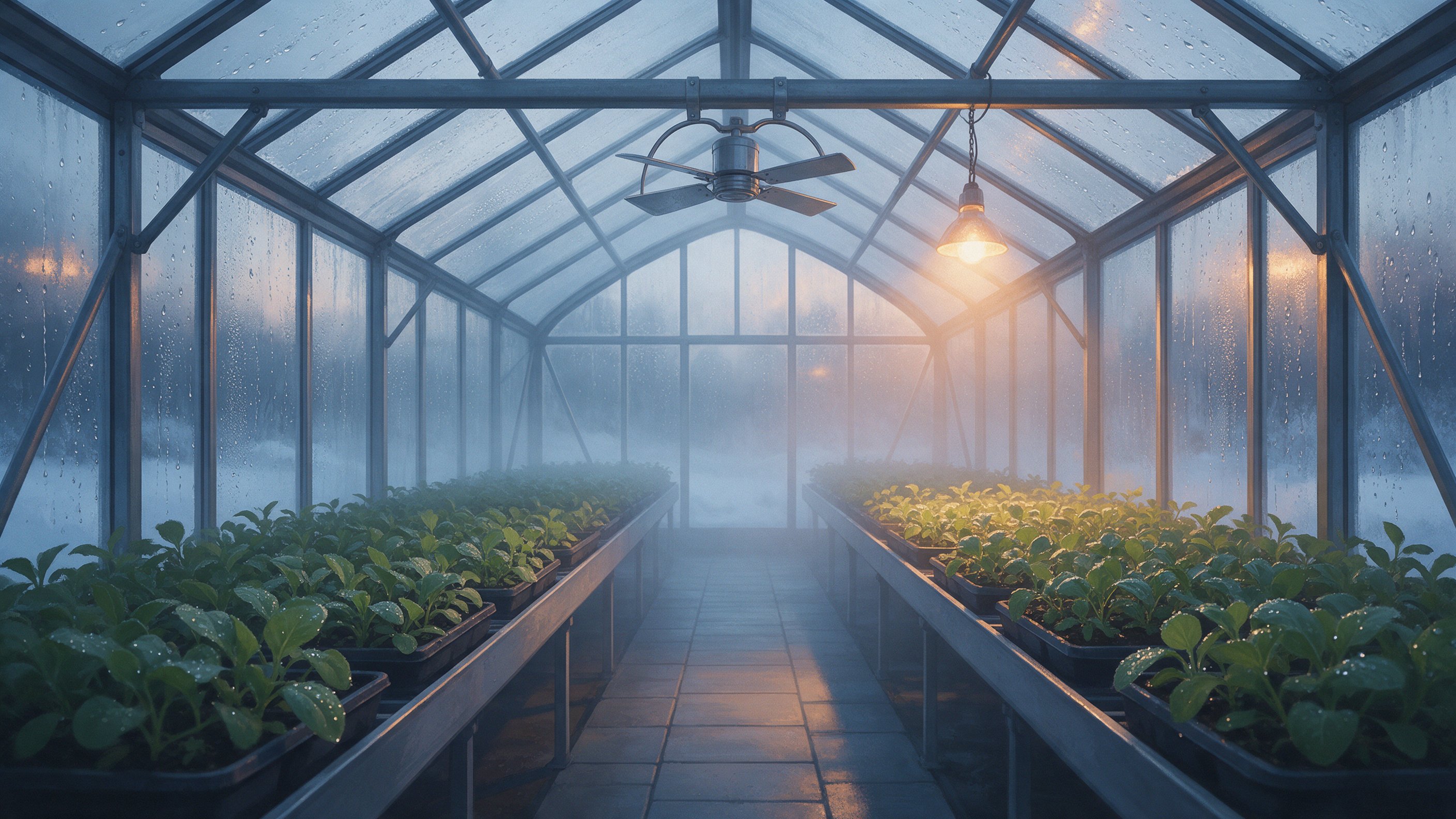
As outdoor temperatures fall, greenhouses are closed to keep heat in, leaving the moisture released by crops and growing media with fewer places to go. Guidance from horticultural distributor Ball Seed's technical services team frames the winter problem plainly: condensation on plant surfaces and structures, uneven temperatures and heavier foliar disease pressure, with heavy venting as a costly remedy that wastes energy and swings temperatures.
Condensation, not a humidity number, is the target
Relative humidity on its own does not predict whether water will form on plants. Condensation appears when a plant or a greenhouse surface cools to the dew point of the surrounding air, defined as the temperature at which relative humidity reaches 100%. In cool weather, glazing, structural components and crop surfaces can all sit below air temperature, so free moisture collects on leaves and creates the conditions foliar pathogens need. Managing humidity is therefore less about holding a particular relative humidity level and more about preventing condensation and the leaf wetness that follows.
Moisture builds up overnight
Warm air holds more water vapor than cool air. Through the day, crops and substrate release moisture into the house through evapotranspiration. As temperatures decline overnight, relative humidity climbs and the margin to the dew point narrows. Because greenhouses are usually kept closed to conserve heat in cold weather, that moisture stays inside; without adequate air movement and ventilation, the air can approach saturation by morning, particularly in cool, stagnant areas of the structure.
Run heating and venting as a pair
Heating and venting look like opposing actions, but the guidance is to use them together. Heating raises air temperature and lowers relative humidity, giving moisture on plants and surfaces a chance to evaporate. Ventilation then exchanges the warm, moisture-laden inside air for cooler outside air in a short exchange often called "burping" the greenhouse. Used in brief cycles, heat-and-vent removes moisture while limiting the energy loss that comes from leaving vents open for extended periods.
Even out the microclimates
Greenhouse climates are rarely uniform. Cooler, more humid pockets tend to develop near sidewalls, corners, doors, curtains and within the crop canopy. Horizontal air flow (HAF) fans mix air throughout the house, reducing temperature and humidity differences between those zones, and consistent air movement also helps moisture evaporate from plant surfaces. Fans alone, however, do not remove moisture from the greenhouse, so once moisture levels become excessive, air movement has to be combined with appropriate ventilation.
Taken together, the advice offers no single humidity setpoint to chase. It treats humidity control as a balance of heat, ventilation and air movement, adjusted as outside temperatures fall and the house stays closed for longer.